LPG cylinder fires are one of the most common — and most misunderstood — emergencies in Thai kitchens, beach restaurants, and street-food carts. Knowing the right sequence in the first thirty seconds is what separates a contained flare-up from a catastrophic explosion.
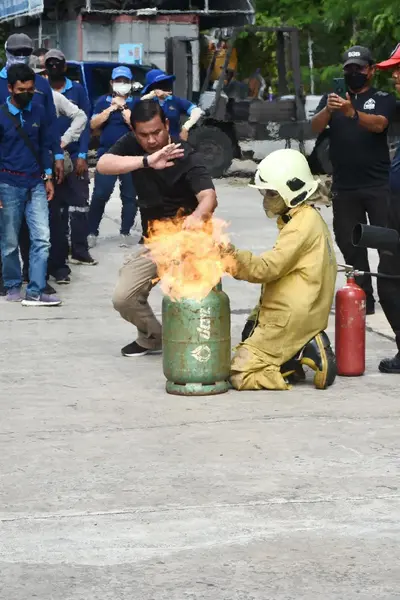
Cut the Fuel First — Close the Valve
A burning LPG cylinder is fed by a continuous stream of gas. The flame itself is not the danger — the gas behind it is. Before you reach for an extinguisher, the priority is to close the cylinder valve (the regulator on top). If you can reach it without the flame between you and your hand, turn it off clockwise until it stops. Once the fuel is cut, most cylinder fires die within seconds.
Approach from an angle where the flame is blowing away from you, not towards you. Wear gloves or wrap a wet cloth around your hand if you have time — the metal valve heats quickly. If you cannot reach the valve safely, do not waste time trying — move to the next step.
Choose the Right Extinguisher
Not every extinguisher works on a cylinder fire. The wrong choice can spread the fire or, in the worst case, trigger an explosion.
- Dry chemical (ABC) — the most common in Thai kitchens and shops. Works well on LPG fires.
- CO2 — excellent for cylinder fires; smothers the flame without leaving residue. Standard in commercial kitchens.
- Wet towel or damp cloth — for small flare-ups at the valve or hose, drape it over the source to cut oxygen.
- Never use water on the flame — water won’t stop the gas, and it can push burning fuel onto a wider area.
The PASS Technique — Adapted for Cylinders
For any portable extinguisher, use the standard PASS method with one cylinder-fire adjustment:
- Pull the pin
- Aim at the base of the flame, not the body of the cylinder
- Squeeze the handle steadily
- Sweep from side to side across the source until the flame is out
The cylinder-specific rule: once the flame is out, keep the cylinder cool. Spray or pour water on the body of the cylinder — not the flame, which is already extinguished — for at least 15 minutes. A hot cylinder can re-ignite or rupture even after the visible fire stops.
What Never to Do
- Do not move a burning cylinder. Heat weakens the metal — sudden movement can rupture it.
- Do not pour water onto the flame. It does not extinguish gas; it spreads fire.
- Do not use a CO2 extinguisher in a small enclosed room without ventilation — risk of asphyxiation.
- Do not assume the fire is out because the flame disappeared. Listen for hissing — leaking gas with no flame is more dangerous than visible fire.
Prevent the leak before it becomes a fire
Most cylinder fires start as undetected leaks. Check the rubber hose for cracks and perishing every few months and replace it on schedule — Thailand’s heat ages rubber fast. Test joints with soapy water, never a flame: bubbles mean a leak. Store cylinders upright, outdoors or in a ventilated space, away from drains and below-ground areas where heavier-than-air LPG can pool. Keep ignition sources clear while connecting a regulator, and make sure staff who handle gas daily are properly trained — the Department of Skill Development (dsd.go.th), the same body that accredits SGS, sets the competency standards that keep commercial kitchens safe. Prevention is far cheaper than the burns and damage a flashover causes; WHO burn-injury guidance (who.int) is blunt about how fast cooking-fuel fires escalate from contained to life-threatening.
After the Fire — Evacuate and Call for Help
Even after the visible flame is out, treat the area as live until the cylinder is cool to the touch and the valve is confirmed shut. Open windows and doors to vent any remaining gas, then evacuate the building.
Call 199 (Thailand fire service) the moment you have hands free — even if the fire appears extinguished. Fire investigators will check for leaks and confirm the cylinder is safe to remove.
The Phuket Numbers You Need
- 199 — Fire service
- 1669 — Emergency Medical Services (ambulance)
- 191 — General police
- 1155 — Tourist Police (English-speaking)
Are your staff trained to act in the first thirty seconds? SGS provides hands-on fire safety training, extinguisher drills, and LPG handling courses for hotels, restaurants, and commercial properties across Phuket. Contact SGS to arrange a session.