Most Phuket hotels compare the wrong two numbers: an outsourced monthly invoice against a guard’s salary. The comparable figure is the fully loaded annual cost of a covered post — and once 168 hours a week are staffed legally, in-house guarding costs roughly four officer packages per post, not three. That gap is where security budgets quietly break. This article rebuilds the comparison properly, so you can price your own site instead of trusting either sales pitch.

The comparison most hotels run is the wrong one
The conversation almost always starts the same way. A GM looks at a contractor’s monthly rate per officer, looks at what the housekeeping supervisor earns, and concludes the contractor is charging a large premium for the same person. On those two numbers, that conclusion is correct — and it is meaningless, because the two numbers describe different things.
The invoice covers a covered post: someone is standing there at 03:00 on a public holiday, and if that person is sick, someone else is. The salary line covers one person’s base pay and nothing else. Between them sit three cost layers that never appear on a payslip: the staffing multiple required to cover 168 hours legally, the employer burden that attaches to every Thai employee, and the supervision and relief structure that makes a post reliable rather than merely staffed.
Price all three and the decision becomes a genuine business case. Skip them and you get the outcome we are called in to fix most often: a property that moved guarding in-house to save money, budgeted three officers per post, and now runs the department on overtime with a duty manager covering supervision at 2am.
The 168-hour problem: one post is not three guards
Start with the arithmetic that drives everything else. A single 24/7 post is 168 hours per week. Thailand’s Labour Protection Act caps ordinary working time at 8 hours per day and 48 hours per week for general work (Department of Labour Protection and Welfare, labour.go.th). Divide 168 by 48 and bare coverage already requires 3.5 full-time officers — before anyone takes a day off.
Now fund the absences the law requires you to grant:
- Annual leave — a minimum of 6 working days per year after one year of service
- Sick leave — up to 30 working days per year, paid
- Public holidays — not fewer than 13 days per year
- Training days — licensing courses and documented refreshers, during which the post still needs covering
- Turnover gaps — the weeks between an officer resigning and a vetted, licensed replacement standing the post
Together these push the realistic figure to 4.0–4.2 officers per 24/7 post. Most in-house budgets are built on three.
The usual workaround is 12-hour shifts with two officers on rotation. It looks efficient on a roster and it is expensive in law: every 12-hour shift carries four hours beyond the daily 8-hour limit, payable at 1.5× the ordinary hourly rate. You end up paying for roughly 14 hours to cover 12 — a permanent premium baked into every single shift, on top of the coverage shortfall it was meant to solve.
The employer burden the salary line never shows
Every directly employed officer carries statutory and practical costs beyond wages:
- Social security — the employer contributes 5% of wages, capped at 750 baht per employee per month against the 15,000 baht wage ceiling (Social Security Office, sso.go.th)
- Workmen’s Compensation Fund — an employer-only annual contribution, rated by the risk classification of the work
- Severance liability — statutory severance scales with service: 30 days’ pay after 120 days, 90 days after one year, 180 days after three, 240 days after six, rising to 400 days at twenty years
- Uniforms and equipment — uniform sets, footwear, radios, torches, wet-weather kit, and their replacement cycle
- Licensing and training — the accredited guard licensing course and refresher training, plus paid time during which someone else covers the post (Department of Skill Development, dsd.go.th)
- Recruitment — advertising, vetting, background checks, onboarding, repeated at every departure
- Administration — payroll, HR records, discipline, and the management hours none of it appears to consume until it does
Severance is the line that catches properties out. It accrues invisibly for years and then lands in one financial period — a restructure, a department closure, a change of operator. A six-year officer represents 240 days of pay. Ten of them represent a number no hotel wants to meet without having funded it.
The layer nobody budgets: supervision and relief
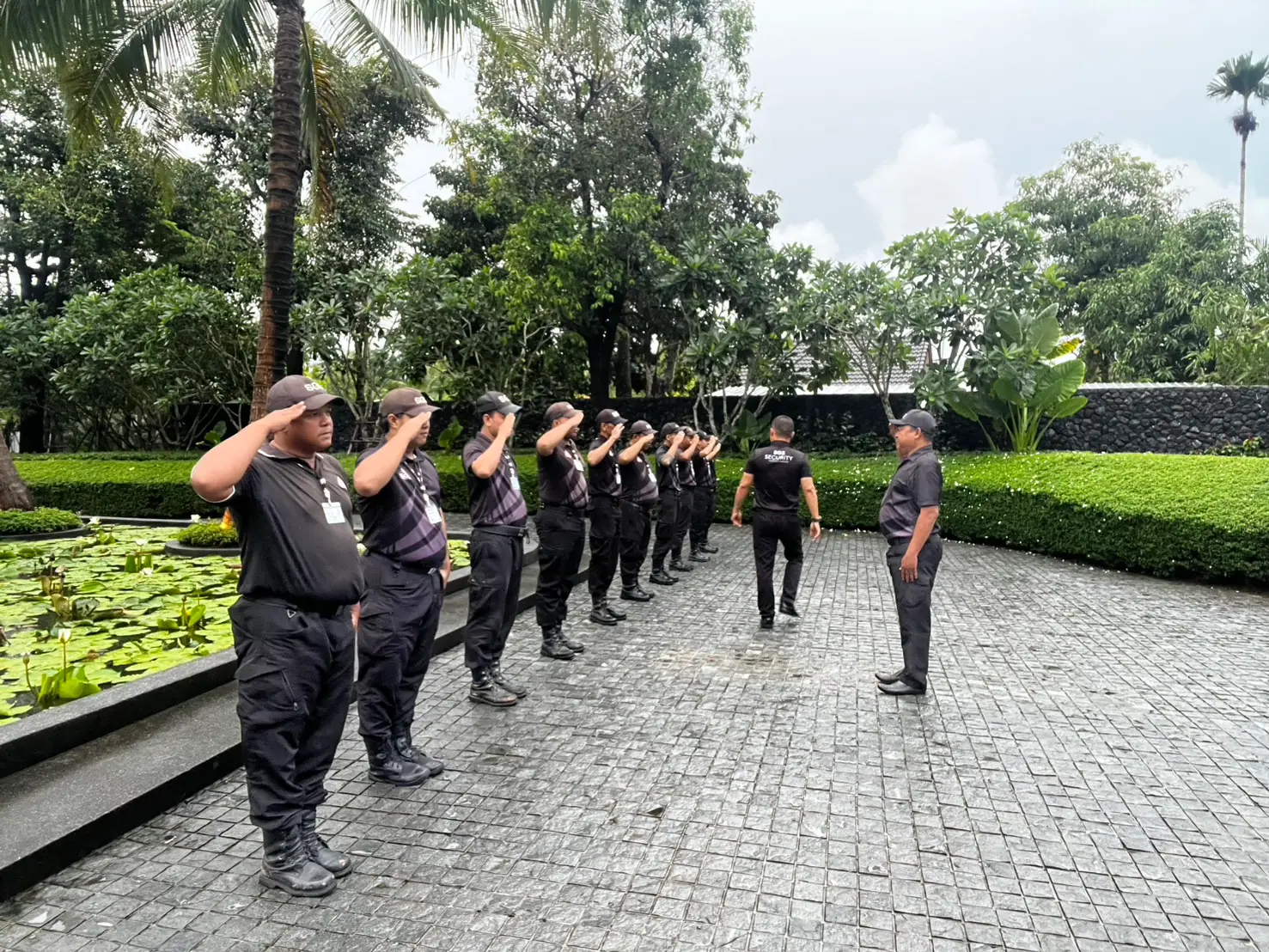
A guard standing a post is the visible part of a security operation. What makes that post reliable is the structure behind it: roving supervisors checking posts through the night, a 24/7 operations centre that answers when the officer does not, and a bench of trained, licensed officers who can cover sickness at short notice without sending a stranger who has never seen the site.
In-house, those functions rarely get funded — they get absorbed. The night duty manager becomes the de facto supervisor. The HR manager becomes the security recruiter. The chief engineer becomes the equipment budget. None of it lands in the security cost centre, so the in-house model looks cheaper than it is while quietly consuming senior hotel management time.
Relief is the same story. A contractor absorbs a no-show inside the agreed rate because they hold a bench across many sites. A single property holds no bench, so absence becomes overtime, and chronic overtime becomes turnover, which becomes recruitment cost — the loop that turns a cost-saving decision into a cost-growth one.
The compliance question that can decide it outright
Thailand’s Security Guard Business Act B.E. 2558 (2015) sets licensing requirements for security businesses and for individual guards, administered through the Royal Thai Police registrar (royalthaipolice.go.th). We covered what to verify in how to choose a security company in Phuket.
The cost implication is about where responsibility sits. Contract a licensed security company in Phuket and verification, individual guard licensing, vetting and the associated legal exposure are the contractor’s obligation — and your insurer sees a licensed operator standing behind any incident. Employ guards directly and the burden of verifying licences, using accredited training and complying with employment law moves to the property, alongside the employment liability itself.
That is not an argument that in-house guarding is improper — plenty of large properties run it well. It is an argument that the compliance workload is a real, recurring cost with a named owner on your org chart, and it belongs in the comparison. Confirm your specific obligations with Thai counsel before moving a guarding function in-house.
Build the comparison properly: a five-line model
Here is the model we use in a security audit. The figures below are illustrative placeholders — substitute your own payroll data and quotes.
1. Establish the staffing multiple. For each 24/7 post, use 4.2 officers. For a 12-hour daytime-only post, use 2.1.
2. Load one officer fully. Taking an illustrative base wage of ฿15,000 per month:
- Base wage — ฿15,000
- Employer social security (5%, capped) — ฿750
- Workmen’s Compensation Fund — approximately ฿75
- Uniform and equipment, amortised — approximately ฿400
- Licensing and refresher training, amortised — approximately ฿400
- Recruitment, amortised over average tenure — approximately ฿300
- Severance accrual (30 days per year of service) — ฿1,250
- Fully loaded monthly cost — approximately ฿18,175
That is roughly ฿218,000 per officer per year — against a headline salary of ฿180,000.
3. Multiply by the staffing multiple. ฿218,000 × 4.2 ≈ ฿916,000 per 24/7 post per year.
4. Add supervision and relief. One roving supervisor plus operations-centre coverage across six posts adds in the order of ฿30,000–40,000 per month loaded — roughly ฿60,000–80,000 per post per year.
5. Read the total. Around ฿980,000–1,000,000 per 24/7 post per year, or ฿82,000–83,000 per month per post — excluding management time, and excluding severance events when they land.
Now compare that against an outsourced quote for the same post, monthly rate × 12. If the contract price sits below the in-house total, outsourcing is cheaper and transfers absence risk, severance liability and compliance exposure with it. If it sits above, ask the contractor to itemise the difference — supervision ratio, training hours, relief depth and turnover rate are where the money legitimately goes, and any reputable company will show you.
Two warnings on the output. A quote dramatically below every other bid has taken the money out of the guard’s wage, the guard’s training or the supervision layer — the three things you are actually buying. And an in-house model that beats the market on paper has almost always been built on three officers per post rather than four.
Where in-house genuinely wins
Outsourcing is not the answer to every property, and it is worth being direct about where a permanent team is better:
- Site knowledge and tenure. An officer who has worked the same resort for six years knows which guest is a returning owner and which contractor should not be back-of-house at midnight. That knowledge is real security value and it compounds.
- Brand and guest interaction. Guest-facing security is part of the service experience. Properties with a strong service culture often want that role trained and appraised inside their own system.
- Direct control. Discipline, scheduling and standards answer to you without a contract variation.
- Scale. Above roughly ten posts, a property can amortise a dedicated security manager, a training budget and a relief bench — the point where in-house economics start to work.
The failure mode is the middle ground: a property with four or five posts that wants in-house control but funds neither the relief bench nor the supervision layer. That combination reliably delivers the highest cost and the weakest coverage at the same time.
Where outsourcing genuinely wins
- Absence risk transfers — a no-show is the contractor’s problem, absorbed inside the agreed rate
- No severance tail — scope down at the end of high season without a redundancy exercise
- Compliance sits with the licence holder — including individual guard licensing and vetting
- Surge capacity — Phuket’s November-to-April swing is a staffing problem for a hotel and a routine roster change for a contractor
- Specialist capability on demand — event security for a wedding or gala, close protection for a VIP arrival, without carrying those skills year-round
- One predictable line item — instead of a payroll, a training budget, an equipment budget and a contingent liability

The hybrid model most Phuket resorts land on
In practice the strongest properties on the island run neither pure model. They keep a small in-house core in the roles where tenure pays — a security manager, a lobby duty officer, a loss-prevention lead — and contract the volume: night perimeter posts, back-of-house patrols, high-season surge, event deployments and all relief cover.
That structure keeps the site knowledge and brand fit of a permanent team while moving the coverage multiple, the severance tail and the absence risk to a contractor who can spread them. It is also the cleanest to budget, because the variable half of the department scales with occupancy instead of sitting fixed through the green season. Our work at Montazure Kamala Residences runs on exactly this shape.
How SGS prices it
We quote hotel and resort security itemised, because the arithmetic above is the whole argument. Every proposal starts with a senior consultant’s site survey that establishes how many posts your property genuinely needs — frequently fewer than requested, once patrol routing and camera coverage are read together — and states the staffing multiple, supervision ratio, training hours and relief arrangement behind the rate. Every other line of our security services in Phuket is priced the same way.
SGS has operated in Phuket since 2007 with more than 300 licensed officers across 40+ properties in Phuket, Khao Lak, Phang Nga and Krabi. Every deployed officer is individually licensed, police-vetted and trained at our own training school before a first shift, and every post runs under written post orders backed by a 24/7 operations centre — the layers that the model above prices, delivered rather than absorbed by your duty managers.
If you are weighing this decision now, the useful first step is not a quote. It is an honest count of your posts and hours. Send us those and we will build the comparison against your numbers, including the case where in-house wins.
- +66 (0) 76 336 084 — SGS 24/7 operations line
- Request a free site assessment — a senior member of our team responds within one business day