The licence course is the floor, not the standard. What decides how a security guard performs at 03:00 is what happened on the property before the first shift — whether anyone walked them to the loading bay, briefed the post orders where they apply, and made them show the drill rather than listen to it. Most buyers never see this part, because it happens at dawn in the back of house. This article shows what good looks like, using two SGS sessions from September 2026.
Licensed is the minimum
Thailand’s Security Guard Business Act B.E. 2558 (2015) requires every guard to hold an individual licence, earned through an accredited course. SGS runs its own training school, accredited by the Department of Skill Development under the Ministry of Labour, and every officer passes through it before a first shift. The course covers the law, first aid, fire response, reporting and the conduct expected of a licensed officer.
What it cannot cover is your property. No classroom teaches which back-of-house door the kitchen props open at 22:00, which condominium entrance is for residents and which for contractors, or where the assembly point is. That knowledge is site-specific, it changes, and it has to be taught on the ground.
What a proper on-site session covers
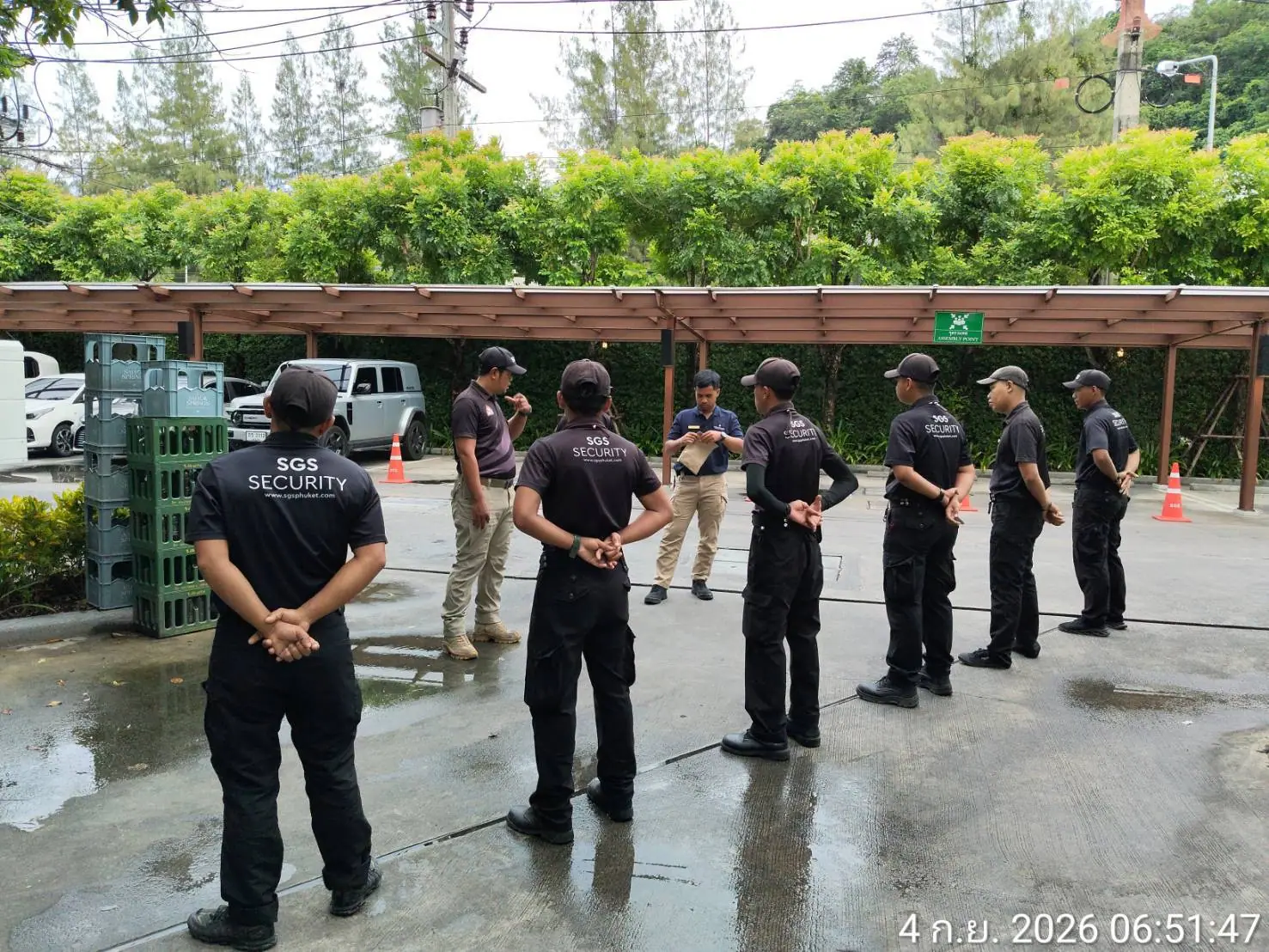
A good on-site session is short, physical and repeated. The one SGS ran on the loading apron at InterContinental Phuket Resort in Kamala was under way at 06:49, before the day shift went to post. It followed the sequence every SGS site uses:
- Muster and dressing — the team falls in, dresses by the right at arm’s length and stands to attention. A line that forms quickly tells the supervisor the team is switched on and puts every officer where they can be counted.
- Turnout inspection — cap, shirt, boots, belt and the SGS ID card visible on the chest, checked officer by officer and corrected on the spot.
- Post orders, briefed and read back — not handed out in a room but briefed at the post they apply to, with each officer repeating what they will do: who is allowed through, what is logged, where the assembly point is.
- Site walk — the loading bay, staff entrance, plant rooms, fire exits and the route guests are led along in an evacuation.
- Salute and reporting — how an officer reports to a supervisor and to the client’s manager, done the same way every time.
- Handover — what the incoming officer is told and what goes in the occurrence book.
The full sequence, with photographs, is in our case study on on-site guard training at InterContinental Phuket and The Title Legendary Bangtao.
Hotels: the risk is behind the lobby
Guests judge a hotel’s security by the lobby. Losses happen behind it. The loading bay is where stock leaves in a contractor’s van, where a delivery driver wanders into a corridor, and where a gas cylinder sits beside a propped fire door. An officer trained only on a plan does not know which door matters at 03:00; one briefed on the apron does. That is why hotel and resort security from SGS starts with the back of house, not the front desk.
New developments: the site changes every week
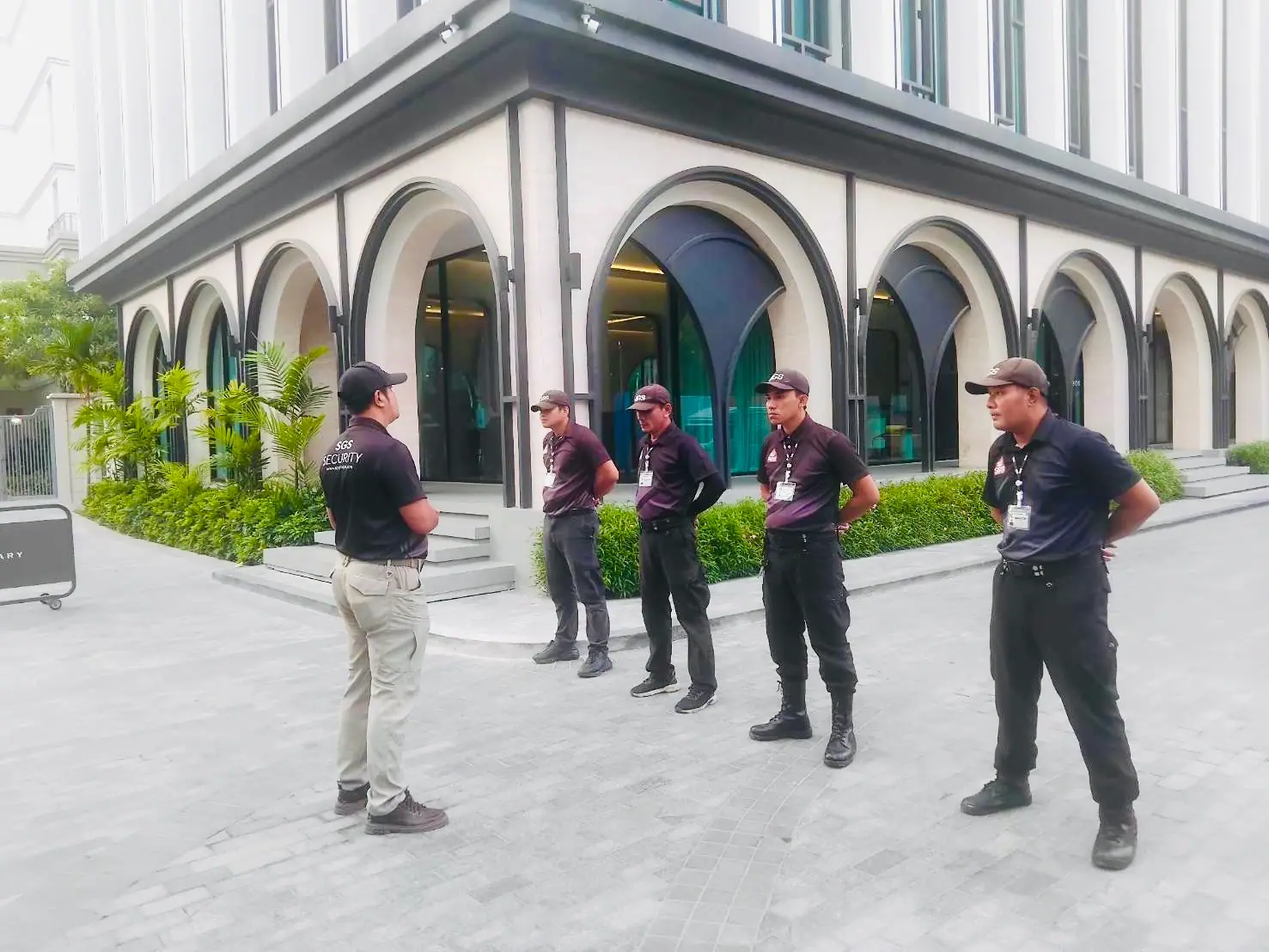
At The Title Legendary in Bangtao, completed buildings, a sales gallery and a live construction interface share one entrance. Residents, contractors and delivery drivers arrive through the same gate with different rules for each, and last month’s post orders are already out of date. Here the on-site session is not a one-off induction but a rhythm: the supervisor re-briefs the gate every time the site changes, and the team drills the new procedure before it is needed.
Five questions to ask your security company
Price and licence are the easy checks. These tell you whether the officers will actually know your property:
- Who trains the officers on our site, and when — before the first shift, or after the first complaint?
- Are post orders written for our property, and are they briefed at the post and read back?
- Do supervisors inspect turnout and run a muster every shift, or only when the client is watching?
- What happens when the site changes — a new contractor, a closed entrance, an event weekend?
- Can we see it? A reputable company will invite you to a dawn muster.
The wider checklist is in how to choose a security company in Phuket.
How SGS runs it
Every SGS officer is individually licensed, police-vetted and trained at our own school before a first shift. They are then inducted on site by an SGS supervisor, under written post orders, with a 24/7 operations centre behind every post. The sessions at InterContinental Phuket Resort and The Title Legendary are what that looks like in practice, and every line of our security services in Phuket runs the same way.
If you want officers who know your property before they stand on it, tell us the site and the number of posts. A senior consultant will survey it and respond within one business day.
- +66 (0) 76 336 084 — SGS 24/7 operations line
- Request a free site assessment — a senior member of our team responds within one business day